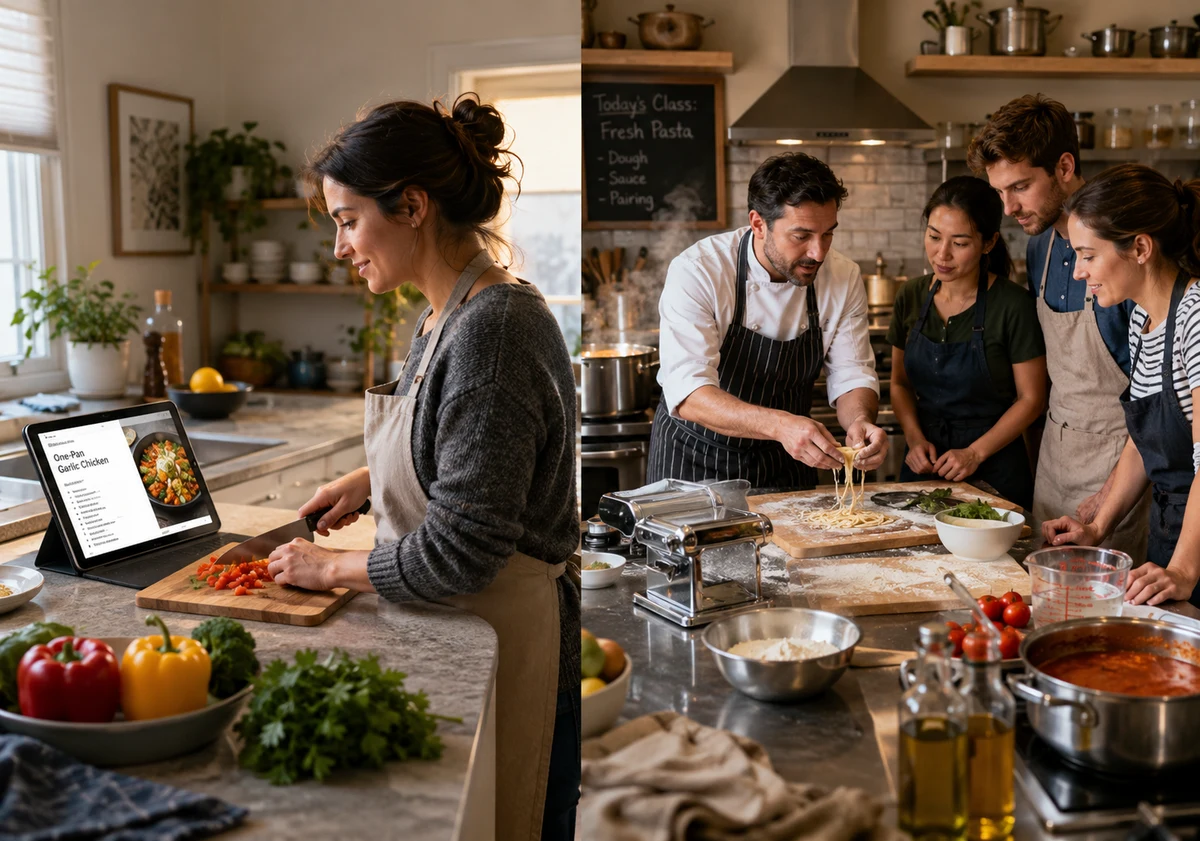
Most home cooks learning to cook have asked themselves this at least once: Do I really need a cooking class, or can I just figure it out at home? Honestly, both paths teach real cooking skills, but they build kitchen confidence at very different speeds.
With self-learning, you explore recipes at your own pace and grow self-assurance through repetition. In a cooking class, an instructor catches mistakes before they become habits. Both approaches offer genuine value, and understanding the difference between them helps you decide which path suits you best.
In this article, you’ll find an honest look at how cooking courses and self-learning each develop culinary techniques. You’ll learn where each one falls short, and which path helps you feel confident in the kitchen quickly.
Keep reading to see which one fits where you are right now.
Cooking Classes vs Self-Learning: What the Difference Really Feels Like
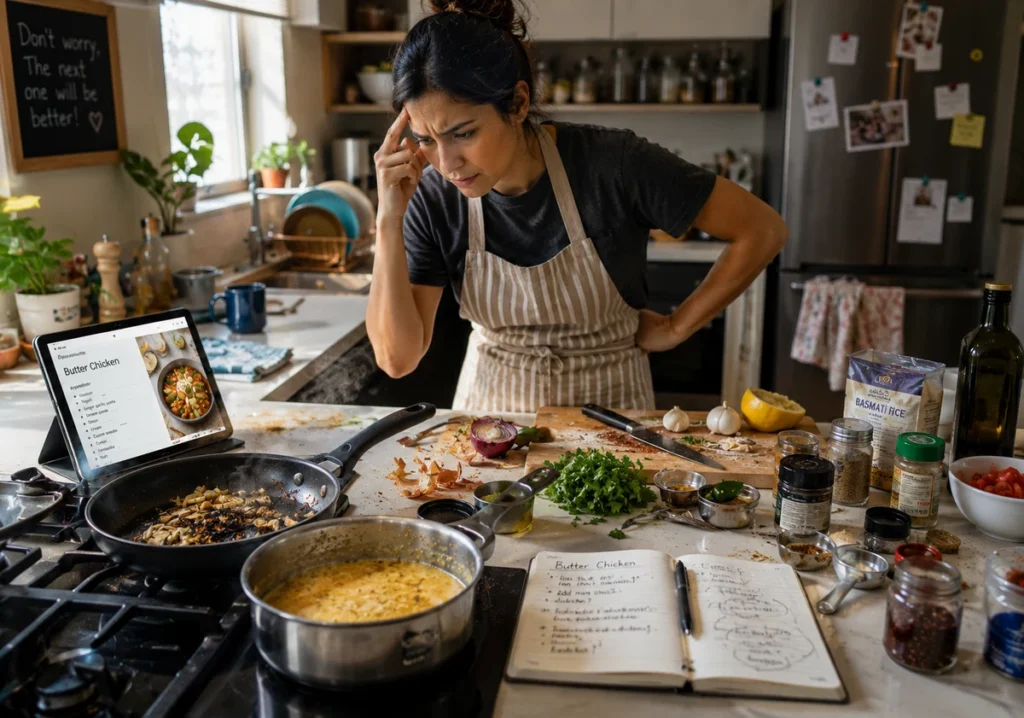
Most home cooks underestimate how quickly their skills improve when someone can correct errors in real-time.
That difference is obvious once you start cooking. In a cooking class, instructors guide students through technique, timing, and preparation step by step, while self-learning relies on repetition, experimentation, and learning from mistakes independently.
That’s why the experience behind each one is worth understanding before you decide which direction to take.
The Cooking Class Experience: Hands-On Skills From Day One
A cooking class gives you something no recipe ever will: immediate feedback.
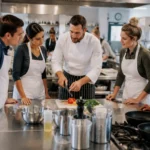
Your instructor sees you grip the knife wrong and corrects it before you repeat the mistake. Plus, you practice cooking techniques with proper equipment in a teaching kitchen. This feels very different from cooking at home on a familiar stove (a home stove forgives a lot of bad habits. A teaching kitchen exposes them).
Group settings also push you further beyond your comfort zone. You attempt dishes you would never try alone, like fresh pasta or a layered tomato sauce, because everyone around you tackles the same challenge together.
Learning at Home: Cooking Shows, Recipes, and Trial and Error
Generally, cooking shows and recipes are genuinely useful since they introduce you to new ingredients, techniques, and ideas at your own pace.
But the limitation appears once you start cooking on your own. When your onions burn or your sauce breaks, the recipe doesn’t tell you what went wrong or how to fix it. And without that feedback, you often repeat the same mistakes without fully understanding what caused them.
Simply put, self-learning can build creativity gradually, but it misses the foundational cooking skills professional kitchens teach from the beginning. As a result, you keep returning to the same familiar dishes instead of confidently branching into more challenging recipes.
Basic Cooking Skills You Actually Build Faster in a Class
Many beginner cooks spend months trying to improve consistency at home, yet struggle with timing, knife control, and heat management. Cooking classes usually accelerate those exact fundamentals while you actively practice them.
In particular, you can develop the following two techniques noticeably faster inside a classroom:
1. Knife Skills and Cooking Techniques No YouTube Video Can Fully Teach
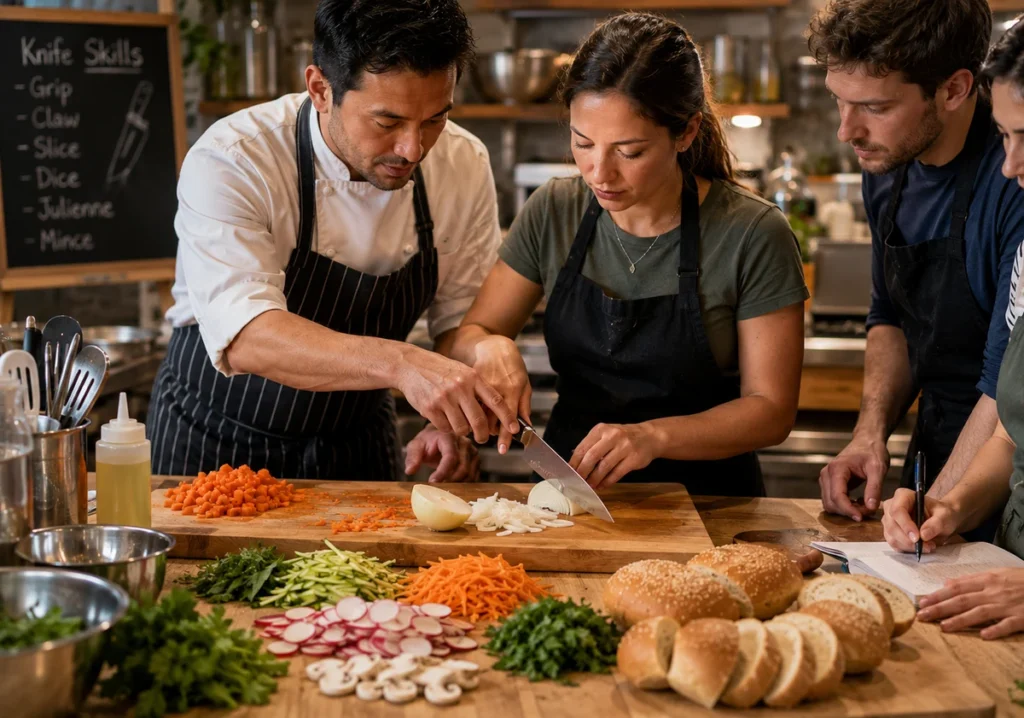
Proper knife grip and blade angle are skills you have to learn through hands-on training rather than just watching. Because when you hold a chef’s knife at the wrong angle, your cuts become slower and less precise. On top of that, a dull knife makes the whole prep process genuinely unsafe.
After working with students at different skill levels, we’ve seen how quickly knife technique clicks when an instructor physically guides your hand through the motion. That correction takes less than a minute, yet many home cooks spend years without it.
Once your knife abilities improve, everyday kitchen tasks become noticeably easier. For example, chopping vegetables to the same size, preparing bread rolls, and slicing onions without tears, all of it gets easier.
2. Reading the Heat: What Culinary School Teaches That Recipes Leave Out
Recipes generally tell you to cook on medium heat or until golden brown. But what they rarely explain is how medium heat actually looks, sounds, and smells in your specific pan.
Cooking classes build that kind of sensory awareness through repetition and direct guidance. So you learn to listen for the sizzle when garlic hits a hot pan with olive oil, to watch how a sauce changes color as it reduces. And to smell when something is thirty seconds from burning.
As those habits develop, mise en place starts becoming second nature. Therefore, you stop scrambling to catch up and begin staying ahead of the cooking process instead.
Without that real-time awareness, many home cooks continue overcooking chicken, breaking tomato sauces, or under-seasoning dishes.
Can You Feel Confident Cooking Without Formal Training?
Yes, but the process usually takes longer because most self-taught cooks repeat the same errors for months before recognising them.
Basically, self-discipline helps you improve steadily at your own pace, but it cannot replace the immediate feedback a cooking class gives from the first session. In practice, an instructor can spot weak technique, explain mistakes, and stop bad habits before they become part of your routine.
Here are four honest realities about building cooking confidence without formal training:
- Slow Progress on Basic Skills: Self-taught cooks can absolutely develop solid basic cooking skills. However, without structured feedback, the same weak spots often keep appearing across different dishes. In fact, you get comfortable with simple recipes and stop pushing further.
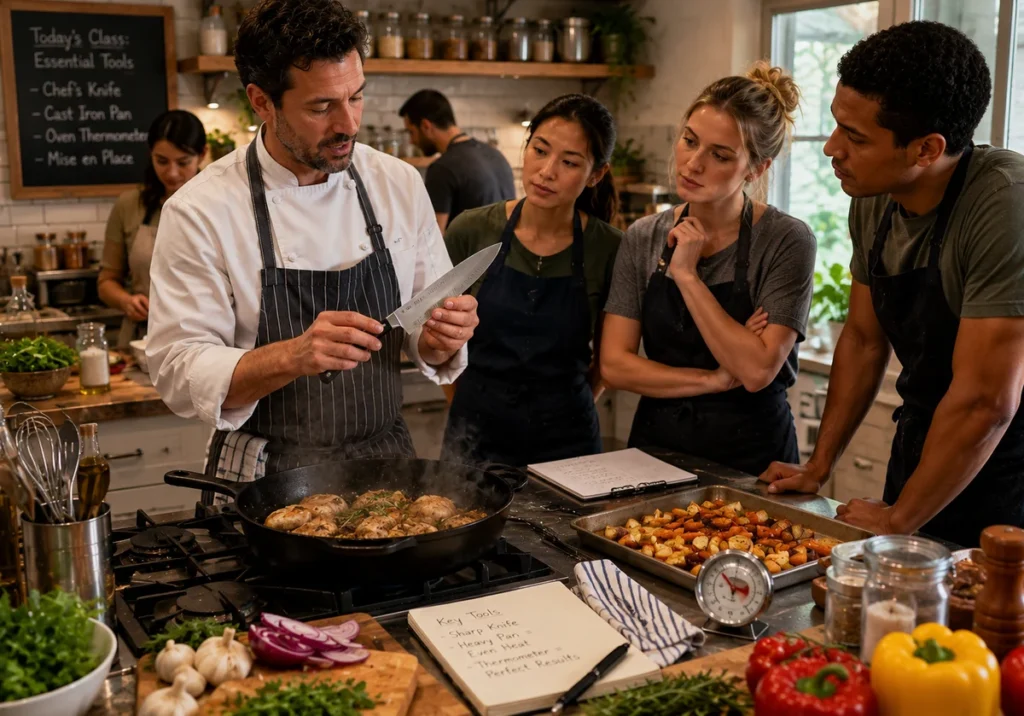
- Essential Tools Take Longer to Learn: Knowing the right tools, like a sharp knife, a heavy pan, or an oven thermometer, can noticeably improve your cooking results. For this reason, cooking classes introduce those essential tools early, while many home cooks only discover their importance after years.
- Cooking Confidence Grows Slower: Confidence in the kitchen comes from repetition paired with correction, not repetition alone. When something goes wrong while you train at home, you often cannot identify the actual cause. So you repeat the same mistake and leave the gap in your knowledge unresolved.
- Fun Working Through New Recipes: In a class, the energy in the room makes unfamiliar dishes feel less intimidating because everyone works through the same challenges together. That shared experience builds stronger kitchen habits faster than solo practice does.
Keep in Mind: You can work through these gaps on your own. But it takes time, focus, and a willingness to start cooking new things even when the results aren’t great yet.
With those realities on the table, here’s where the conversation gets a little more personal.
Which Path Actually Builds Real Cooking Confidence?
Cooking classes and self-learning both offer true value, but they develop kitchen control in very different ways.
Generally, cooking classes develop confidence quickly by combining hands-on experience with immediate instructor feedback. So, you learn how to taste as you cook, adjust seasoning mid-dish, and understand why a recipe works instead of simply following instructions step by step.
From our experience running classes at Fiore, cooks who combine structured lessons with regular home practice usually develop stronger kitchen habits than those relying on only one method.
However, self-learning still brings real advantages to your cooking journey. A few of them are worth noticing:
- Cooking shows introduce you to new flavor combinations and global techniques at no cost.
- Simple recipes build repetition and help you get comfortable with timing and portions.
- Meal prep at home sharpens your instinct for seasoning, texture, and adjusting a dish to your own taste.
Even so, professional chefs don’t develop culinary arts by watching videos alone. They stand in a kitchen alongside experienced cooks who can correct mistakes and learn from them directly. That foundational knowledge sticks in a way that trial and error alone rarely produces.
Verdict: Self-learning has genuine merit as a supplement. But for building genuine culinary techniques from the ground up, a cooking class gives you a faster, cleaner start. Think of it as your best friend in the kitchen who actually knows what they’re doing.
Your Next Meal Starts With One Good Decision
Cooking courses and self-study both teach you something real. Cooking classes give you structure, correction, and the kind of culinary skills that stay from the very first session. By contrast, learning at home gives you freedom, creativity, and the confidence to experiment with new recipes on your own terms.
If you’re ready to stop guessing and start cooking with assurance, Fiore Restaurant’s culinary classes will be a great place to begin. Our instructors work with home cooks at every skill level, from pasta basics to full Italian meals.
Visit fiorerestaurant.net to find a class and taste the difference a single session can make.